
How to Get Your Small Business Found on Google (Without an Agency)

Getting your small business found on Google comes down to three things: making sure Google knows you exist, making sure your website matches what people are actually searching for, and building enough trust signals that Google is confident showing you to its users. None of this requires an agency, but it does require knowing where to start. This guide walks you through exactly what to do, in the right order, so you don’t waste time on the wrong things.
Step 1: Claim Your Google Business Profile (This Is Non-Negotiable)
Your Google Business Profile is the listing that appears when someone searches for your business name, or for businesses like yours near their location. It is what powers the map results, the group of three businesses that appear at the top of Google when someone types “digital marketing agency near me” or “SEO help for small business.”
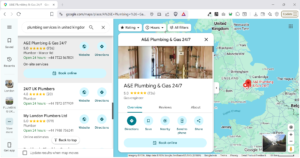
If you haven’t claimed yours, you’re invisible in those results, regardless of how good your website is.
To claim your Google Business Profile:
- Go to business.google.com and sign in with your Google account.
- Search for your business name. If it already exists as an unclaimed listing, claim it. If not, create a new one.
- Choose the correct business category. This is one of the strongest signals Google uses to decide when to show you.
- Add your address or service area. If you work from home and don’t want to display your address, you can hide it and list your service areas instead.
- Add your phone number and website URL.
- Verify your profile. Google will send a postcard to your address with a verification code, or in some cases, offer phone or video verification.
Once verified, do not stop there. A half-completed profile is almost as invisible as no profile at all.
Fill in every section: your hours, a full business description (use the words your customers would use, not industry jargon), your services, photos of your work or your workspace, and your opening hours. Businesses with complete profiles receive significantly more views and clicks than those with sparse listings.
Step 2: Make Sure Your Website Uses the Words Your Customers Actually Search For
Google matches websites to search queries by reading the words on your pages. If someone searches “SEO help for small business UK” and your homepage talks about “digital solutions” and “strategic growth partnerships,” Google has no way of knowing you’re relevant to that search.
This doesn’t mean stuffing your website with keywords until it reads as if a robot wrote it. It means writing clearly about what you actually do, in the language your customers use.
Start with your homepage. Ask yourself: if someone who had never heard of my business landed on this page, would they immediately know what I do, who I help, and what to do next? If the answer is no, that is your first priority.
Then think about what your ideal customer would type into Google when they need what you offer. Not what you call your services, but what they call them. A customer doesn’t search “content strategy consultancy.” They search “someone to write my website copy” or “blog writing for small business.”
Use those phrases naturally in your page titles, your headings, and the first paragraph of your key pages. You don’t need every keyword in every sentence. You need the right words in the right places.
If you have separate services, for example, SEO, website management, and paid ads, each service should have its own page. Google can only rank one page for one query. A single “services” page that briefly mentions everything will not rank for anything in particular.
Step 3: Get Listed in UK Directories
Google trusts your business more when other credible sources consistently mention it. This is called citation building, and for a small UK business, it is one of the fastest ways to improve your local search visibility.
The directories worth your time are:
- Yell.com
- Thomson Local
- Bing Places for Business (free, separate from Google, and worth doing)
- Apple Maps Connect (increasingly important as more people use Siri and Apple devices to search)
- Free Index
- The FreeIndex and Bark.com if you offer services
The critical rule: your business name, address, and phone number must be identical across every listing. Even small inconsistencies, “Ltd” versus “Limited,” a different phone number format, reduce Google’s confidence in your information and can hurt your local rankings.
Set aside an afternoon to create or claim your listings on each platform. It is a one-time investment that keeps paying off.
Step 4: Ask Every Happy Customer for a Google Review
Reviews are one of the most powerful ranking signals for local Google search, and they are completely free.
Businesses with more recent, detailed, positive reviews rank higher in Google Maps results than businesses with fewer or older reviews. According to Google’s own documentation, prominence, which includes reviews, is one of the three core factors used to determine local search rankings.
More importantly for your business, potential customers read reviews before they contact you. A business with 12 genuine, detailed reviews from real clients will win enquiries over a competitor with a better website but no reviews.
After every positive client interaction, ask for a review. Send a short email or WhatsApp message with a direct link to your Google Business Profile review form. You can find this link in your Business Profile dashboard under “Get more reviews.” The easier you make it, the more reviews you’ll receive.
Respond to every review you get. Publicly thanking people for their time and acknowledging specific feedback shows Google and prospective customers that you are active, attentive, and professional.
Step 5: Create Content That Answers the Questions Your Customers Are Already Asking
Google increasingly rewards businesses that demonstrate real knowledge and genuine helpfulness. One of the most effective ways to do this without a large budget is to write content that directly answers the questions your ideal customers are typing into search engines.
Think about the questions you get asked most often. What do clients ask before they hire you? What do people not understand about your industry? What would save them time, money, or frustration to know before making a decision?
Each of those questions is a potential blog post. And each blog post is another page that Google can rank, giving potential customers another entry point to find you.
You don’t need to publish every day. One genuinely useful, well-written post per month is far more effective than ten thin, rushed articles. Write for the person, not for the algorithm. If your content genuinely helps someone who lands on it, Google will notice.
A practical starting point: write a guide that answers the most common questions you receive from new clients. Keep it specific, keep it honest, and make sure the answer to the main question appears in the first paragraph.
What Doesn’t Work (And What to Stop Wasting Time On)
A few things that get talked about constantly but are not the priority for a new or small business:
Obsessing over keyword density. Writing naturally and covering a topic thoroughly will always beat counting how many times a keyword appears.
Chasing backlinks from irrelevant websites. A genuine mention in a relevant blog or directory is worth more than fifty links from unrelated sites.
Trying to rank nationally before you have a local authority. Competing for broad national terms like “digital marketing agency UK” as a new business is extremely difficult. Start with specific, lower-competition terms that describe exactly what you do and where you do it.
Ignoring technical basics. A slow website, one that doesn’t work on mobile, or one with broken links, will struggle to rank, no matter how good the content is. If your website takes more than 3 seconds to load on a phone, fix that first. (We’ve written a separate guide on why websites slow down and what to do about it. It’s worth a read before you invest more time in content.)
How Long Until You See Results?
Honest answer: It depends on how competitive your market is, how well your website is set up, and how consistently you work on this. But here is a realistic timeline for most small UK businesses starting from scratch:
Weeks 1–2: Claim and complete your Google Business Profile. This can begin showing results within days of your business appearing in local map searches, almost immediately after verification.
Weeks 3–4: Get listed in key UK directories. Consistent citations start improving your local authority within a few weeks.
Month 2–3: Your first few pieces of content start getting indexed. You may begin appearing for specific long-tail search terms.
Months 3–6: Rankings begin to climb for the terms you’ve focused on. Organic traffic is starting to arrive with more consistency.
Month 6+: Compounding returns. Each piece of content and each review adds to a growing foundation. This is when SEO starts to feel like a real business asset rather than a marketing task.
The businesses that win at this are the ones that start now and stay consistent. Not the ones who do a burst of activity and then stop for three months.
When Does It Make Sense to Get Professional Help?
If you have completed the basics above and you’re still not seeing the results you need, or if you simply don’t have the time to do this consistently alongside running your business, professional SEO support is worth serious consideration.
The return on investment calculation is straightforward: if the time you spend on SEO each week is worth more to your business when spent on client work, delivery, or business development, then outsourcing the SEO work makes financial sense.
At Vabe Digital, we work with small businesses and female founders who want to grow their organic visibility without becoming SEO experts themselves. Our SEO Kickstart package starts at £750 as a one-off fee, or £400 per month on a rolling retainer. Both include a thorough audit of your current setup so you know exactly where you stand before any work begins.
If you’d like an honest conversation about where your business stands and what would actually move the needle, book a free 30-minute call to get clarity.
Getting your business found on Google is not a one-time task; it is an ongoing process that builds on itself over time. The businesses that show up consistently are the ones that started, stayed consistent, and invested time in the fundamentals before chasing shortcuts.
If you’d like help with any of this or want to know exactly where your website stands right now, our free 30-minute SEO audit call is a good place to start. No commitment, no jargon. Just honest feedback on what’s working and what to focus on next.
Frequently Asked Questions
How do I get my small business found on Google for free?
Claim and fully complete your Google Business Profile, ensure your website uses the words your customers search for, get listed in UK directories like Yell and Thomson Local, and consistently collect genuine customer reviews. These four steps are the foundation of local search visibility and can all be done without paid advertising or agency fees.
How long does it take to get found on Google?
For local map results via Google Business Profile, visibility can improve within days of verification. For organic website rankings, most small businesses see meaningful results within 3 to 6 months of consistent effort, though competitive markets and newer websites may take longer. The most important factor is starting and staying consistent.
Do I need a website to appear on Google?
No, you can appear in Google’s local map results through your Google Business Profile without a website. However, a website significantly increases your visibility, credibility, and the range of searches you can appear for. For most businesses, even a simple, well-optimised website is worth having alongside a Google Business Profile.
Why isn’t my business showing up on Google?
The most common reasons a small business doesn’t appear on Google are: an unclaimed or incomplete Google Business Profile, a website that doesn’t use the words customers actually search for, too few or no customer reviews, inconsistent business information across directories, or a slow or technically broken website that Google struggles to crawl properly.
